
 |
Case Report
Outcomes of a late sequential cochlear implantation: A case report
1 Audiologist and Phoniatrist, Medical Director, San Luca Medicina & Riabilitazione, Battipaglia, Italy
2 Audiologist and Phoniatrist, Medical Director, San Pio Medical Center, Battipaglia, Italy
3 Speech Therapist, San Luca Medicina & Riabilitazione, Battipaglia, Italy
4 Psychologist-Psychotherapist, San Luca Medicina & Riabilitazione, Battipaglia, Italy
Address correspondence to:
Rossana Santimone
Via Don Michele Paesano, 65 Eboli, SA,
Italy
Message to Corresponding Author
Article ID: 100017Z18RS2025
Access full text article on other devices

Access PDF of article on other devices


How to cite this article
Santimone R, Votta M, Vecchione N, Adesso A. Outcomes of a late sequential cochlear implantation: A case report. J Case Rep Images Otolaryngol 2025;4(2):9–12.ABSTRACT
Introduction: Sequential cochlear implantation is a rehabilitative strategy for patients with bilateral profound sensorineural hearing loss who receive the second implant years after the first. When sequential cochlear implantation is performed after a long interval, there are many uncertainties about the outcomes achieved with the second device.
Case Report: This study presents the case of a 24-year-old patient, implanted on the right ear in 2007 and on the left ear in 2023. The objective was to assess the speech therapy outcomes obtained with the second implant and compare them with those of the first. After the left implant was activated, the patient underwent a speech therapy program designed to achieve balanced bilateral auditory input. Postoperative evaluations revealed rapid adaptation to the new auditory stimulus, with steady progress in sound discrimination and verbal comprehension. After 12 months, performance with the second implant was comparable to that of the first, both in word recognition tests and in speech perception in complex acoustic contexts.
Conclusion: These results suggest that despite the long interval between the two implants, the brain retains significant auditory plasticity. This plasticity may involve cortical reorganization or strengthened commissural pathways, allowing effective acquisition with the first implant to have facilitated the integration of the second one, thereby optimizing the rehabilitative process. This case confirms the effectiveness of sequential cochlear implantation even when the second implant is performed in adulthood, supporting the hypothesis that binaural stimulation promotes better speech perception and higher quality of life.
Keywords: Auditory plasticity, Cochlear implant, Sequential implantation, Speech therapy
Introduction
Bilateral cochlear implantation can be performed simultaneously or sequentially based on hearing loss and patient age, although global consensus on sequential implantation remains unresolved [1].
Cochlear implantation in early-deafened patients, implanted as adolescents or adults, is not always advised due to poor expected outcome [2].
The use of the bilateral cochlear implants (CIs) can promote the symmetrical development of the central auditory pathways, tasked with recognizing, localizing and comprehending target signals.
Combined input from the two cochleae serves to confer the auditory stimulus a depth and directionality through summation, the head shadow effect, and binaural squelch [3].
This results in improved speech recognition, sound quality, and localization as compared with monaural hearing [4],[5].
These results suggested that late second implantation might be associated with improvement auditory outcomes [1].
Bilateral cochlear implantation aims to realize this benefit and can be performed simultaneously or, more often in adults, sequentially with a variable time interval between the first (CI1) and the second (CI2) implant [6],[7].
Patients undergoing bilateral sequential CI, even with a long interval between procedures, presented high indices of quality of life [8].
For the sequential procedure, a question related to the impact of the time interval between the first and second surgeries regarding the post-surgical results is discussed [9].
Early-deafened, late-implanted adolescents and adults, constitute a unique group of cochlear implant (CI) users, showing a large variability in outcome. Analysis of the outcomes identified that communication mode (in childhood), preoperative speech intelligibility, and preoperative speech recognition scores were significantly related to speech perception outcomes for this group of CI users [10].
Case Report
A 24-year-old woman with bilateral sensorineural hearing loss diagnosed at one year of age was initially rehabilitated with bilateral hearing aids. Since 2007, cochlear implant surgery has been performed on the right ear with the use of a hearing aid in the contralateral ear.
Genetic analyses excluded the presence of mutations in the GJB2 gene and branchio-oto-renal syndrome (BOR); furthermore, ear malformations were excluded.
In October 2023, the patient voluntarily decided to undergo CI surgery on the left side, with subsequent activation in November of the same year.
After the new CI was activated, the patient began attending a weekly speech therapy program, which also included specific tasks to be completed at home.
The work focused on the following areas:
- identification of vowels;
- identification of consonants;
- identification of words;
- recognition of words;
- recognition of parts of sentences and phrases;
- comprehension of sentences;
- expansion of vocabulary.
From the outset, the medical team overseeing patient’s surgery and the activation of both implants informed the patient that the recovery of the ear implanted in 2023 would not equal the performances of the ear implanted in 2007.
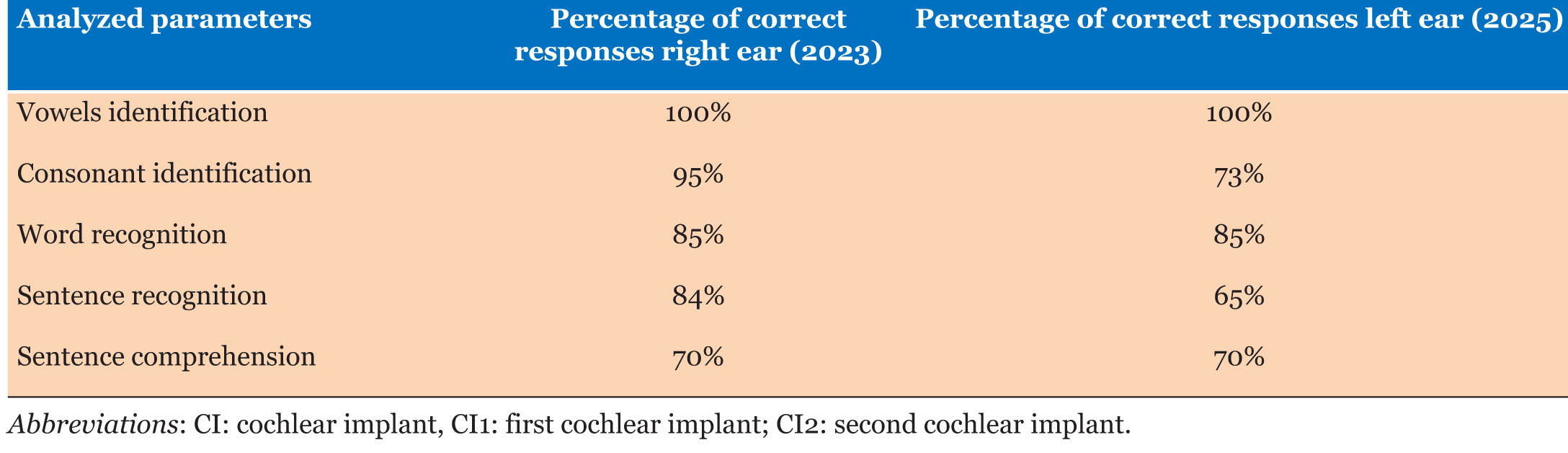
To objectively evaluate the patient’s skills in the left ear, she underwent the ICARE Rehabilitation Audiology Outcomes Evaluation Protocol in February 2025, yielding the following outcomes:
- vowel identification: 100% correct answers;
- consonant identification: 73% correct answers;
- recognition of two-syllable words: 85% correct answers;
- sentence recognition: 65% correct answers;
- sentence comprehension: 70% correct answers.
The results obtained were compared with those obtained in 2023 on the right ear (last evaluation of the right ear) and are shown in Table 1.
The patient underwent cognitive assessments, consisting of the Wechsler Adult Intelligence Scale-IV (WAIS-IV) and Vineland-II – Adaptive Behavior Scales –Second Edition (VINELAND II).
The patient shown total Intelligence Quotient (IQ) of 62, which is below average for her age and displayed average adaptive abilities, with a deviation IQ of 91.
Discussion
This case highlights the positive outcomes achievable with late sequential cochlear implantation, even after a prolonged interval.
The patient overcame concerns about decreased auditory plasticity and potential difficulties in adapting to a second implant after many years, achieving comparable performance with the C2 to that of the C1, within 15 months of activation. This suggests that the auditory system can retain significant plasticity into adulthood. The bilateral stimulation provided by sequential implantation appears to enhance speech perception and overall auditory performance.
Conclusion
The case study presented above sought to illustrate how continuous and unchanging speech therapy rehabilitation, supported by work carried out at home, led to optimal and unpredictable results. This single case shows that with determination and consistent support, favorable outcomes can be achieved in sequential cochlear implantation, even after a prolonged interval.
REFERENCES
1.
Deniz H. Auditory performance and cortical plasticity following late sequential cochlear implantation. Audiol Neurootol 2025:1–9. [CrossRef]
[Pubmed]

2.
Debruyne JA, Janssen AM, Brokx JPL. Systematic review on late cochlear implantation in early-deafened adults and adolescents: Clinical effectiveness. Ear Hear 2020;41(6):1417–30. [CrossRef]
[Pubmed]
3.
Smilsky K, Dixon PR, Smith L, Shipp D, Ng A, Millman T, et al. Isolated second implant adaptation period in sequential cochlear implantation in adults. Otol Neurotol 2017;38(8):e274–81. [CrossRef]
[Pubmed]
4.
Hawley ML, Litovsky RY, Culling JF. The benefit of binaural hearing in a cocktail party: Effect of location and type of interferer. J Acoust Soc Am 2004;115(2):833–43. [CrossRef]
[Pubmed]
5.
Akeroyd MA. The psychoacoustics of binaural hearing. Int J Audiol 2006;45 Suppl 1:S25–33. [CrossRef]
[Pubmed]
6.
Kraaijenga VJC, van Zon A, Smulders YE, Ramakers GGJ, Van Zanten GA, Stokroos RJ, et al. Development of a squelch effect in adult patients after simultaneous bilateral cochlear implantation. Otol Neurotol 2016;37(9):1300–6. [CrossRef]
[Pubmed]
7.
Peters BR, Wyss J, Manrique M. Worldwide trends in bilateral cochlear implantation. Laryngoscope 2010;120 Suppl 2:S17–44. [CrossRef]
[Pubmed]
8.
Mendes LCDL, Borges A, Caldas F, Barbosa JP, Bahmad F Jr. Late bilateral sequential cochlear implant and quality of life. Int Arch Otorhinolaryngol 2024;28(2):e263–77. [CrossRef]
[Pubmed]
9.
Lammers MJW, Venekamp RP, Grolman W, van der Heijden GJMG. Bilateral cochlear implantation in children and the impact of the inter-implant interval. Laryngoscope 2014;124(4):993–9. [CrossRef]
[Pubmed]
10.
Debruyne JA, Janssen AM, Brokx JPL. Systematic review on late cochlear implantation in early-deafened adults and adolescents: Predictors of performance. Ear Hear 2020;41(6):1431–41. [CrossRef]
[Pubmed]
SUPPORTING INFORMATION
Acknowledgments
Artificial intelligence (AI) use in the article: ChatGPT (GPT-4, Open AI, 2025) was used to assist in drafting and translating parts of the manuscript. All content was reviewed and approved by the author.
Author ContributionsRossana Santimone - Conception of the work, Design of the work, Acquisition of data, Analysis of data, Drafting the work, Revising the work critically for important intellectual content, Final approval of the version to be published, Agree to be accountable for all aspects of the work in ensuring that questions related to the accuracy or integrity of any part of the work are appropriately investigated and resolved.
M Votta - Acquisition of data, Analysis of data, Drafting the work, Final approval of the version to be published, Agree to be accountable for all aspects of the work in ensuring that questions related to the accuracy or integrity of any part of the work are appropriately investigated and resolved.
N Vecchione - Acquisition of data, Drafting the work, Final approval of the version to be published, Agree to be accountable for all aspects of the work in ensuring that questions related to the accuracy or integrity of any part of the work are appropriately investigated and resolved.
A Adesso - Revising the work critically for important intellectual content, Final approval of the version to be published, Agree to be accountable for all aspects of the work in ensuring that questions related to the accuracy or integrity of any part of the work are appropriately investigated and resolved.
Guaranter of SubmissionThe corresponding author is the guarantor of submission.
Source of SupportNone
Consent StatementWritten informed consent was obtained from the patient for publication of this article.
Data AvailabilityAll relevant data are within the paper and its Supporting Information files.
Conflict of InterestAuthors declare no conflict of interest.
Copyright© 2025 Rossana Santimone et al. This article is distributed under the terms of Creative Commons Attribution License which permits unrestricted use, distribution and reproduction in any medium provided the original author(s) and original publisher are properly credited. Please see the copyright policy on the journal website for more information.


